 Add to Chrome
 Add to Firefox
 Add to Edge
JMed48k: A Multi-Profession Japanese Medical Licensing Benchmark for Vision-Language Model Evaluation
May 21, 2026
We introduce JMed48k, a multi-profession Japanese healthcare licensing benchmark for evaluating vision-language models. Built from official PDF materials released by the Japanese Ministry of Health, Labour and Welfare, JMed48k contains 48,862 exam questions and 20,142 images from 11 national licensing examinations between 2005 and 2025, with visual content annotated under an 8-type taxonomy. From this corpus, we derive JMed48k-Eval, a recent five-year evaluation subset with 12,484 scored questions, including 9,905 text-only questions and 2,579 questions with images. We evaluate 21 proprietary, open-source, and medical-specific models, reporting text-only and with-image performance separately. Because these subsets contain different questions, we further introduce a paired image-removal audit that evaluates questions with images before and after removing visual content to explore four answer-transition states. The audit shows that proprietary and open source models gain substantially from images, whereas medical-specific systems show limited observable use of visual evidence, with many correct answers persisting after image removal. Even among proprietary models, the net image-removal effect varies sevenfold across professions, from +5.7 points on Physician questions to +39.8 points on Public Health Nurse questions. We release JMed48k to support reproducible, profession-stratified evaluation of vision-language models in medical licensing settings.

Omanic: Towards Step-wise Evaluation of Multi-hop Reasoning in Large Language Models
Mar 17, 2026Reasoning-focused large language models (LLMs) have advanced in many NLP tasks, yet their evaluation remains challenging: final answers alone do not expose the intermediate reasoning steps, making it difficult to determine whether a model truly reasons correctly and where failures occur, while existing multi-hop QA benchmarks lack step-level annotations for diagnosing reasoning failures. To address this gap, we propose Omanic, an open-domain multi-hop QA resource that provides decomposed sub-questions and intermediate answers as structural annotations for analyzing reasoning processes. It contains 10,296 machine-generated training examples (OmanicSynth) and 967 expert-reviewed human-annotated evaluation examples (OmanicBench). Systematic evaluations show that state-of-the-art LLMs achieve only 73.11% multiple-choice accuracy on OmanicBench, confirming its high difficulty. Stepwise analysis reveals that CoT's performance hinges on factual completeness, with its gains diminishing under knowledge gaps and errors amplifying in later hops. Additionally, supervised fine-tuning on OmanicSynth brings substantial transfer gains (7.41 average points) across six reasoning and math benchmarks, validating the dataset's quality and further supporting the effectiveness of OmanicSynth as supervision for reasoning-capability transfer. We release the data at https://huggingface.co/datasets/li-lab/Omanic and the code at https://github.com/XiaojieGu/Omanic.
Med-CoReasoner: Reducing Language Disparities in Medical Reasoning via Language-Informed Co-Reasoning
Jan 13, 2026While reasoning-enhanced large language models perform strongly on English medical tasks, a persistent multilingual gap remains, with substantially weaker reasoning in local languages, limiting equitable global medical deployment. To bridge this gap, we introduce Med-CoReasoner, a language-informed co-reasoning framework that elicits parallel English and local-language reasoning, abstracts them into structured concepts, and integrates local clinical knowledge into an English logical scaffold via concept-level alignment and retrieval. This design combines the structural robustness of English reasoning with the practice-grounded expertise encoded in local languages. To evaluate multilingual medical reasoning beyond multiple-choice settings, we construct MultiMed-X, a benchmark covering seven languages with expert-annotated long-form question answering and natural language inference tasks, comprising 350 instances per language. Experiments across three benchmarks show that Med-CoReasoner improves multilingual reasoning performance by an average of 5%, with particularly substantial gains in low-resource languages. Moreover, model distillation and expert evaluation analysis further confirm that Med-CoReasoner produces clinically sound and culturally grounded reasoning traces.
From Chains to Graphs: Self-Structured Reasoning for General-Domain LLMs
Jan 07, 2026Large Language Models (LLMs) show strong reasoning ability in open-domain question answering, yet their reasoning processes are typically linear and often logically inconsistent. In contrast, real-world reasoning requires integrating multiple premises and solving subproblems in parallel. Existing methods, such as Chain-of-Thought (CoT), express reasoning in a linear textual form, which may appear coherent but frequently leads to inconsistent conclusions. Recent approaches rely on externally provided graphs and do not explore how LLMs can construct and use their own graph-structured reasoning, particularly in open-domain QA. To fill this gap, we novelly explore graph-structured reasoning of LLMs in general-domain question answering. We propose Self-Graph Reasoning (SGR), a framework that enables LLMs to explicitly represent their reasoning process as a structured graph before producing the final answer. We further construct a graph-structured reasoning dataset that merges multiple candidate reasoning graphs into refined graph structures for model training. Experiments on five QA benchmarks across both general and specialized domains show that SGR consistently improves reasoning consistency and yields a 17.74% gain over the base model. The LLaMA-3.3-70B model fine-tuned with SGR performs comparably to GPT-4o and surpasses Claude-3.5-Haiku, demonstrating the effectiveness of graph-structured reasoning.
Toward Global Large Language Models in Medicine
Jan 05, 2026Despite continuous advances in medical technology, the global distribution of health care resources remains uneven. The development of large language models (LLMs) has transformed the landscape of medicine and holds promise for improving health care quality and expanding access to medical information globally. However, existing LLMs are primarily trained on high-resource languages, limiting their applicability in global medical scenarios. To address this gap, we constructed GlobMed, a large multilingual medical dataset, containing over 500,000 entries spanning 12 languages, including four low-resource languages. Building on this, we established GlobMed-Bench, which systematically assesses 56 state-of-the-art proprietary and open-weight LLMs across multiple multilingual medical tasks, revealing significant performance disparities across languages, particularly for low-resource languages. Additionally, we introduced GlobMed-LLMs, a suite of multilingual medical LLMs trained on GlobMed, with parameters ranging from 1.7B to 8B. GlobMed-LLMs achieved an average performance improvement of over 40% relative to baseline models, with a more than threefold increase in performance on low-resource languages. Together, these resources provide an important foundation for advancing the equitable development and application of LLMs globally, enabling broader language communities to benefit from technological advances.
Investigating the Multilingual Calibration Effects of Language Model Instruction-Tuning
Jan 04, 2026Ensuring that deep learning models are well-calibrated in terms of their predictive uncertainty is essential in maintaining their trustworthiness and reliability, yet despite increasing advances in foundation model research, the relationship between such large language models (LLMs) and their calibration remains an open area of research. In this work, we look at a critical gap in the calibration of LLMs within multilingual settings, in an attempt to better understand how the data scarcity can potentially lead to different calibration effects and how commonly used techniques can apply in these settings. Our analysis on two multilingual benchmarks, over 29 and 42 languages respectively, reveals that even in low-resource languages, model confidence can increase significantly after instruction-tuning on high-resource language SFT datasets. However, improvements in accuracy are marginal or non-existent, resulting in mis-calibration, highlighting a critical shortcoming of standard SFT for multilingual languages. Furthermore, we observe that the use of label smoothing to be a reasonable method alleviate this concern, again without any need for low-resource SFT data, maintaining better calibration across all languages. Overall, this highlights the importance of multilingual considerations for both training and tuning LLMs in order to improve their reliability and fairness in downstream use.
The Evolving Landscape of Generative Large Language Models and Traditional Natural Language Processing in Medicine
May 15, 2025Natural language processing (NLP) has been traditionally applied to medicine, and generative large language models (LLMs) have become prominent recently. However, the differences between them across different medical tasks remain underexplored. We analyzed 19,123 studies, finding that generative LLMs demonstrate advantages in open-ended tasks, while traditional NLP dominates in information extraction and analysis tasks. As these technologies advance, ethical use of them is essential to ensure their potential in medical applications.
HealthGenie: Empowering Users with Healthy Dietary Guidance through Knowledge Graph and Large Language Models
Apr 20, 2025Seeking dietary guidance often requires navigating complex professional knowledge while accommodating individual health conditions. Knowledge Graphs (KGs) offer structured and interpretable nutritional information, whereas Large Language Models (LLMs) naturally facilitate conversational recommendation delivery. In this paper, we present HealthGenie, an interactive system that combines the strengths of LLMs and KGs to provide personalized dietary recommendations along with hierarchical information visualization for a quick and intuitive overview. Upon receiving a user query, HealthGenie performs query refinement and retrieves relevant information from a pre-built KG. The system then visualizes and highlights pertinent information, organized by defined categories, while offering detailed, explainable recommendation rationales. Users can further tailor these recommendations by adjusting preferences interactively. Our evaluation, comprising a within-subject comparative experiment and an open-ended discussion, demonstrates that HealthGenie effectively supports users in obtaining personalized dietary guidance based on their health conditions while reducing interaction effort and cognitive load. These findings highlight the potential of LLM-KG integration in supporting decision-making through explainable and visualized information. We examine the system's usefulness and effectiveness with an N=12 within-subject study and provide design considerations for future systems that integrate conversational LLM and KG.
Exploring the Role of Knowledge Graph-Based RAG in Japanese Medical Question Answering with Small-Scale LLMs
Apr 16, 2025Large language models (LLMs) perform well in medical QA, but their effectiveness in Japanese contexts is limited due to privacy constraints that prevent the use of commercial models like GPT-4 in clinical settings. As a result, recent efforts focus on instruction-tuning open-source LLMs, though the potential of combining them with retrieval-augmented generation (RAG) remains underexplored. To bridge this gap, we are the first to explore a knowledge graph-based (KG) RAG framework for Japanese medical QA small-scale open-source LLMs. Experimental results show that KG-based RAG has only a limited impact on Japanese medical QA using small-scale open-source LLMs. Further case studies reveal that the effectiveness of the RAG is sensitive to the quality and relevance of the external retrieved content. These findings offer valuable insights into the challenges and potential of applying RAG in Japanese medical QA, while also serving as a reference for other low-resource languages.
JiraiBench: A Bilingual Benchmark for Evaluating Large Language Models' Detection of Human Self-Destructive Behavior Content in Jirai Community
Mar 27, 2025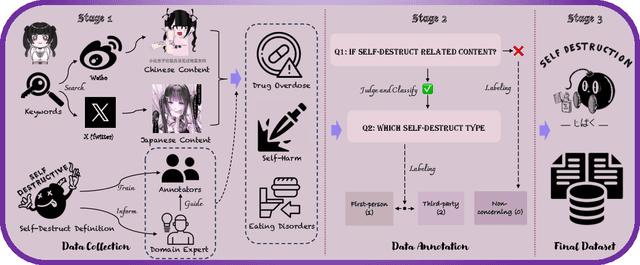
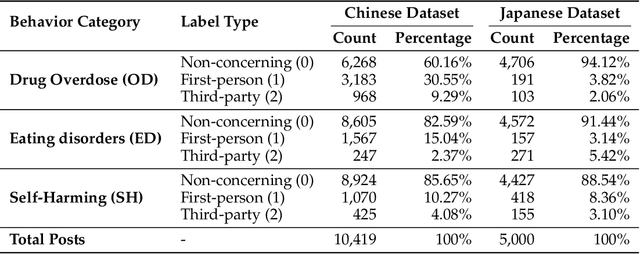
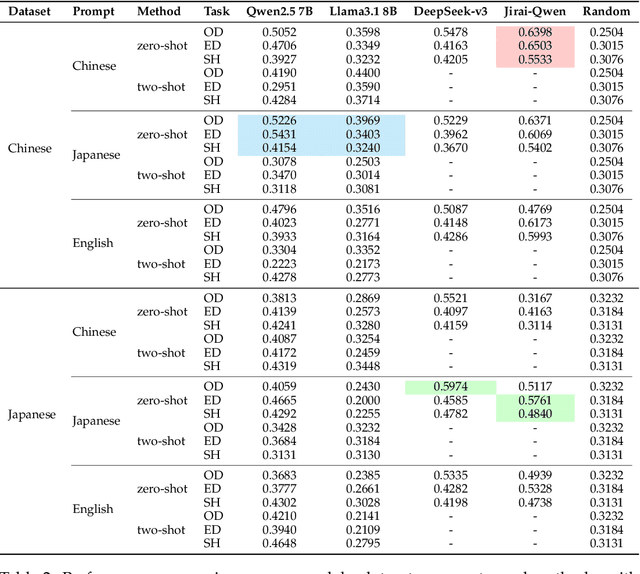
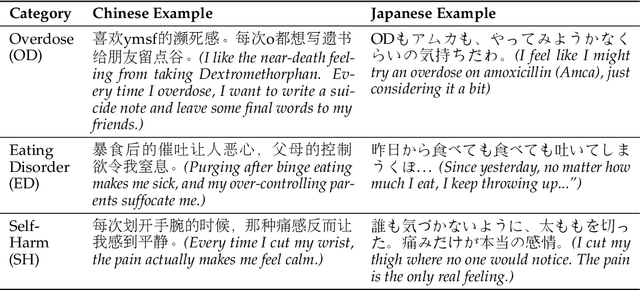
This paper introduces JiraiBench, the first bilingual benchmark for evaluating large language models' effectiveness in detecting self-destructive content across Chinese and Japanese social media communities. Focusing on the transnational "Jirai" (landmine) online subculture that encompasses multiple forms of self-destructive behaviors including drug overdose, eating disorders, and self-harm, we present a comprehensive evaluation framework incorporating both linguistic and cultural dimensions. Our dataset comprises 10,419 Chinese posts and 5,000 Japanese posts with multidimensional annotation along three behavioral categories, achieving substantial inter-annotator agreement. Experimental evaluations across four state-of-the-art models reveal significant performance variations based on instructional language, with Japanese prompts unexpectedly outperforming Chinese prompts when processing Chinese content. This emergent cross-cultural transfer suggests that cultural proximity can sometimes outweigh linguistic similarity in detection tasks. Cross-lingual transfer experiments with fine-tuned models further demonstrate the potential for knowledge transfer between these language systems without explicit target language training. These findings highlight the need for culturally-informed approaches to multilingual content moderation and provide empirical evidence for the importance of cultural context in developing more effective detection systems for vulnerable online communities.